① Light is Expanded
Light emitted from the optical fiber is expanded into a wider, collimated beam by a compact ball lens. The beam diameter becomes significantly larger than the fiber core.
Technology
Why expanded beam technology matters.
Physical contact connectors can be sensitive to contamination, creating field maintenance burden.
Expanded beam technology is designed to help reduce that burden.
How It Works
An expanded beam connector removes direct fiber-to-fiber contact. A compact precision lens expands light into a collimated beam, allowing it to pass through an air gap and then be refocused by the mating lens.
Light emitted from the optical fiber is expanded into a wider, collimated beam by a compact ball lens. The beam diameter becomes significantly larger than the fiber core.
The expanded collimated beam passes through the lens-based interface. Since polished fiber end faces do not need to touch, mechanical wear at the optical interface can be reduced.
The lens in the mating connector refocuses the beam into the receiving fiber core. This structure does not rely on spring pressure or direct ferrule-to-ferrule contact.
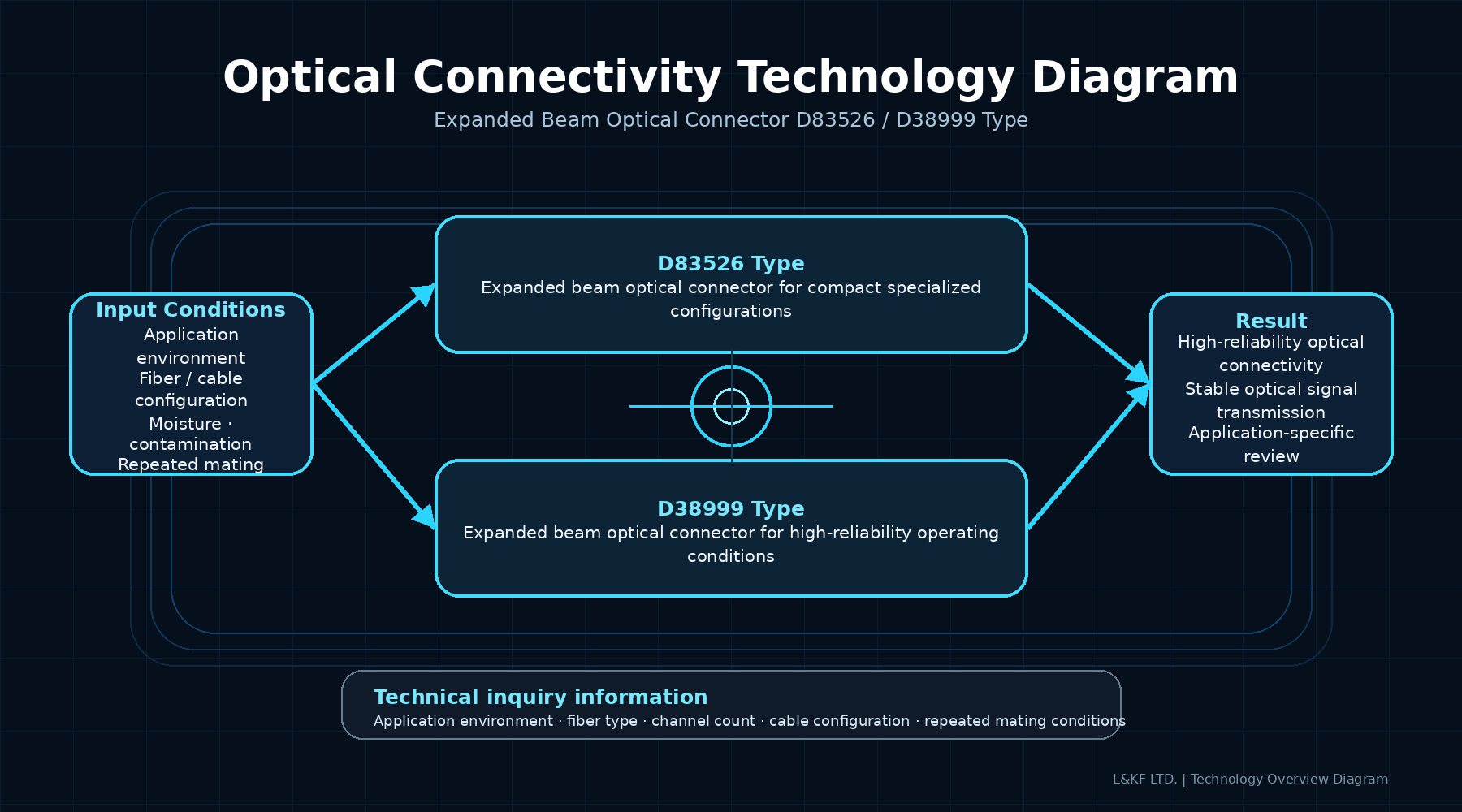
Technology Diagram
Depending on the operating environment and configuration requirements, D83526 or D38999-based platforms can be reviewed.
Contamination Resistance
The core diameter of a single-mode optical fiber is approximately 9µm. A single airborne dust particle can be large enough to affect signal transmission in a physical contact connector.
At an expanded beam interface, the beam area can be approximately 2,000 times larger than a single-mode fiber core, and about 150 times larger than a multimode fiber core.
As a result, the same dust particle may block only a small portion of the expanded beam, allowing most of the optical signal to pass with limited additional loss.
Detailed values may vary depending on product model, channel count, cable configuration, and operating environment. Please contact L&KF for confirmed specifications.
Environmental Durability
L&KF reviews expanded beam connector configurations based on rugged shell platforms, considering water resistance, shock, vibration, temperature, and field operation requirements.
D38999-based configurations may be reviewed for IP67-level requirements, while D83526-based Senior, Junior, and Mini configurations may be reviewed for submersion-oriented operating conditions depending on the selected platform.
Depending on platform and test conditions, expanded beam connector configurations can be reviewed against drop, vibration, and mechanical shock requirements representative of vehicles, aircraft, and naval operating environments.
Temperature performance depends on the selected shell, cable, sealing structure, and test standard. L&KF reviews temperature requirements together with the operating environment and cable configuration.
Application Environments
Expanded beam connectors are especially meaningful in environments where contamination, repeated mating, and field maintenance limitations must be considered.
In industrial environments where dust, oil, and vibration are common, contamination sensitivity in physical contact connectors can increase maintenance burden and downtime. Expanded beam structures can support easier field-level optical link maintenance.
In maritime environments exposed to salt spray and moisture, sealed optical interface concepts and water-protection-oriented structures can support long-term operational reliability review.
In applications with frequent mating and unmating, physical contact connectors may accumulate ferrule wear and performance degradation. Expanded beam technology reduces reliance on direct fiber end-face contact.
In mud, sand, freezing conditions, or extreme temperature environments, expanded beam connector configurations can be reviewed where optical communication must be maintained without specialized field maintenance.
Share your operating conditions and requirements with L&KF. We will review the appropriate expanded beam connector type and cable configuration direction.